Twelve years ago my friend Harry asked me to go on a 10-mile run with him. It was going to be his last long run before the Austin Half Marathon. Harry was competing in the Austin Distance Challenge, had the lead in his age division, and wanted to keep his lead. He wanted me to go on his last long run with him so I could keep him on pace.
But the thing was, I’d never run 10 miles. My daily runs were 5 and 6 miles, and I’d eek out a 7- or 8-miler on the weekend. I hadn’t dipped my toes into double-digit mileage. Hadn’t even considered it. There was no reason for me to do so. But Harry asked me to run 10 miles with him like it was no big deal. And Harry very much knew my weekly volume, which was far from anything big or noteworthy. So, I accepted, like it was no big deal.
But it WAS a big deal. I hung up the phone with Harry and told Elise, “He wants me to run 10 miles with him on Thursday evening.” I think that phone call was on Monday or Tuesday. I had no idea how the hell I was going to prepare or be able to run 10 miles in just a few short days. I was stressed. I was a nervous wreck in the days leading up to the big 10-miler.
Harry showed up to the house on time that Thursday evening. And before I knew it or had time to sheepishly make excuses to Harry in case I couldn’t make it 10 miles, we were jogging down my street, set out on our 10 miler. I guess we were doing this thing.
I don’t remember what all we talked about, but we talked. A lot. That helped make put the miles behind us. Harry’s a personal trainer, so I sought his wisdom after we’d hit mile 7 or 8. I asked him what I should do after this epic haul. I’d already told him that Elise had a frozen chicken fettuccini Alfredo in the oven, so my big meal was planned. He said an ice bath could help with any inflamation. I don’t think I even had any inflamation, but when we were done with our 10 mile run I assumed I was going to be inflamed as all get-out, so I emptied the freezer of all its ice, put it into the tub, filled it with cold water, and plunked my naked self into the bathtub. I was so miserably uncomfortable. It was horrible. But I figured had to somehow recover from this huge mileage endeavor. Elise still laughs about that ice bath.
Twelve-plus years later and this is just what I do on a Tuesday before a full day.
Those are words I vividly remember from a cooking class I took that was taught by Jeff Blank, may he rest in peace. Jeff said, “you know, if you change three ingredients in a recipe you can call it your own.”
As running frequently immitates life, I’ve changed three ingredients in my usual marathon training block. Run training can and should be very personalized and systematic, but also very fluid and open to change.
Without getting all philosophical about it, here are the three things ingredients I’ve changed in this block building up to Boston 2026:
Volume. I’ve simply added more running for more weekly mileage. I’d probably average 50 miles per week in previous training cycles, topping at 55 mpw on peak weeks. Now I’m shooting for 60 mpw. Most of those miles are slow and easy.
Five peak weeks. In the last ~10 marathons I’d build 3 peak weeks in the second half of the macrocycle. I started this cycle with a strong enough base that I built out five peak weeks, all culminating with a 20+ mile long run on Sundays. This ties into #1 above in incorporating more volume, but also just training my body and mind to 20+ consecutive miles in preparation for the marathon. There is a down week between each peak week.
Two-a-days. Wednesdays have historically been a long(er) easy run, bookended by a hard workout on Tuesday and a tempo run on Thursday. Usually a Wednesday would be mileage between 4-10 miles. I’ve now changed that to where it’s still a slow and easy run, but I do one in the morning at my usual run time, and one in the evening after a full day of work and life. Presently (9 weeks out from race day) I’ll run 5 miles in the a.m. and 5 miles in the p.m. That evening run is hard, after a full day, especially considering I’m on my feet most of the day and my job can often be labor intensive.
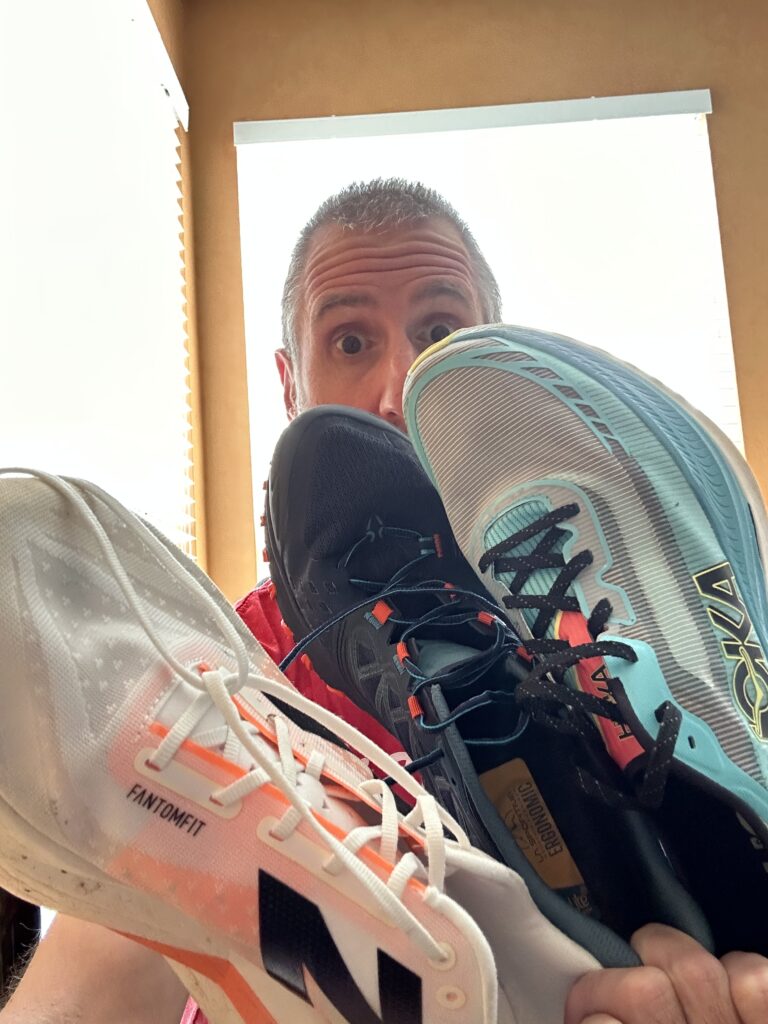
I’ve been testing the HOKA Cielo X1 2.0, the La Sportiva Bushido III, and the FuelCell SuperComp Elite v4.
Running shoe model names have gotten a little out of hand these days. I remember when minivans became the popular norm in the 80’s and brands did whatever they could to make the minivan more sleek and sexy. That turned into a focus on aerodynamics and curved lines, to the point where I very clearly remember my dad saying, as we were driving east on I-10 nearing Houston, “The more minivans they make, the more they make them look like suppositories.”
Check out ACTIVE.com for their annual Fall and Spring running shoe reviews. And as you do that, don’t believe what you read in online shoe reviews.
Support your local run specialty store and get yourself fitted for shoes. Like no two snowflakes are alike, no pair of feet on this earth are alike. And like the old adage: “if the shoe fits, wear it.” You need to find the shoe that fits and feels like it was made for your foot. And the only way to do that is to put them on your feet and try them out. A good run specialty store will do that for you.
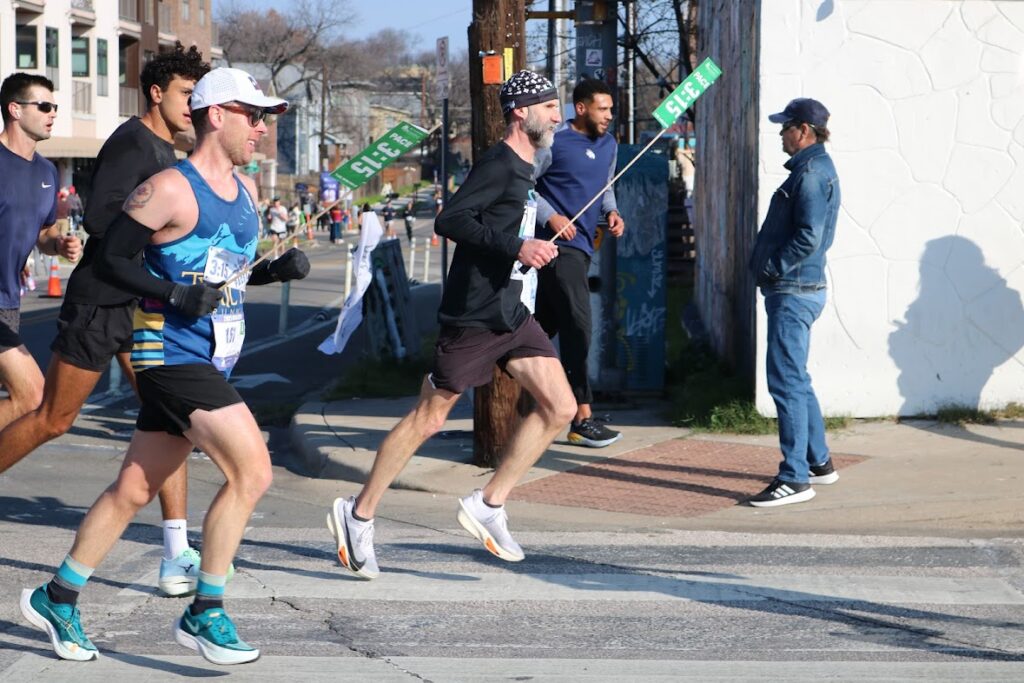
Today I failed. Nate and I paced the 3:15 group for the Austin Marathon. We nailed the first mile split and ended up being hot on pace until around mile 24 when my wheels started falling off. I’ve yet to run the enirety of the Austin Marathon. I’ve run it three times officially now. Today wasn’t the day, and that just happens sometimes. It was cold and windy for the entire race. The temperatures were fine, but wind is my running kryptonite. The wind took the wind out of my sail. I let my head to go a dark place and I failed to pull myself out of it. My left glute flared up early and moved to my hip in the late miles. There’s something wrong in that muscle group, so I’m just going to lay low and give it the time it needs to heal.
Austin’s a hard course. One day I’ll beat it.
I failed to hit a 3:14:30. Instead I came in at 3:16:40. I failed my team and crew. I hold myself to some standards. “Fail” isn’t a bad word in my book. It’s an opportunity to reflect and learn. One of the reasons I love this sport is because I’m always learning.
This was my 11th marathon and the one that I was most anxious about. It’s one thing to be responsible for the outcome of your own race, but it’s another thing to have others relying on you to hit a specific time.
On January 19, 2025 Conner Mantz set a new American record for the half marathon in Houston, coming in at 59:17. The previous record of 59:43 was set my Ryan Hall on the same course in 2007.
This was an amazing and awesome experience to witness in person.
When I first started running, I of course went to the internet to find and read everything that I could about running. And I remember it was very daunting. Like anything on the internet, there’s just too much and you have to be discerning lest you get the wrong information and end up hurting yourself and your running and life improving journey comes to a screeching halt.
You and your running are unique to you, and only to you. You can read and research and experiment and try new things, but always remember that sentence above. And another thing to remember: comparison is the thief of joy. Running should be fun and provide you with fulfillment and joy. Full stop. And you can endeavor upon that journey on your own, as I did or you can seek the help, guidance, and experience of a good coach. I good coach is like a fiduciary. A good coach should and will obligate themselves to act and work in what is in the best interest for you.
Now going back to being discerning. I read and watch a lot of content on the subject of running, training, and coaching. Most of that content I take very seriously for the athletes that I work with and for my own personal knowledge and training. Some of that subscribed content is less serious and what I’d consider more of entertainment.
A good example of what I consider less serious is Marathon Handbook. Granted, there is some useful information on their website and in their newsletter, but they’re running a business there, and their content is intended to reach a mass audience. They do also solicit individualized coaching, and that’s where you have to be discerning. Realize and understand that a lot of their (and other sources and [barf] “influencers”) content is published so they can make money by earning an affiliate commission on product recommendations, advertising revenue, paid subscriptions, and other means.
Marathon Handbook sends a lot of emails. Too many in my opinion. I think one email per week would suffice. I think they send a daily email and you can reduce that cadence to three, maybe four per week, which is, in my opinion still too much. In my opinion, there are a lot of stretches in terms of content and, if I’m being frank, clickbait.
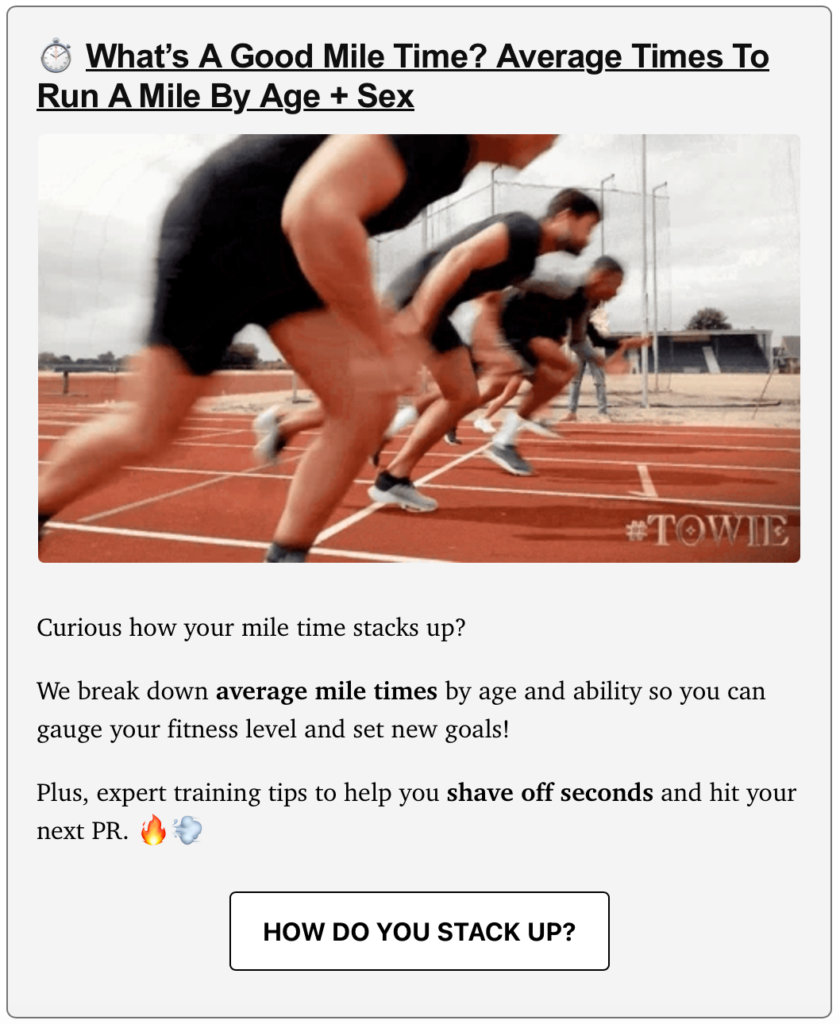
For example:
Right from headline it’s enticing you to compare yourself to everyone else, or to some arbitrary standard. And the call to action button at the bottom plainly asks “how do you stack up?” Remember: comparison is thief of joy. Don’t click on it, or anything otherwise that asks you to compare yourself to others or some standard. Yes, they’ve include some science and research and reference Daniels’ VDOT based on VO2 Max, but ask yourself honestly, does it really matter? It only matters if you let or you want it to matter. When I look at how my mile PR “stacks up,” it puts me somewhere between “high-level recreational” and “sub-elite.” Okay. I don’t know what I’m supposed to do with that. Feel inadequate is my first thought. Should I train to run a faster mile so I can be within in the “sub-elite” classification? I guess I could, but why? Maybe if I were training for the mile it might mean more; but really, what does it mean? I’m not going to line up at the Fifth Avenue Mile in New York City and mutter, “excuse me, excuse me, sub-elite coming through.”
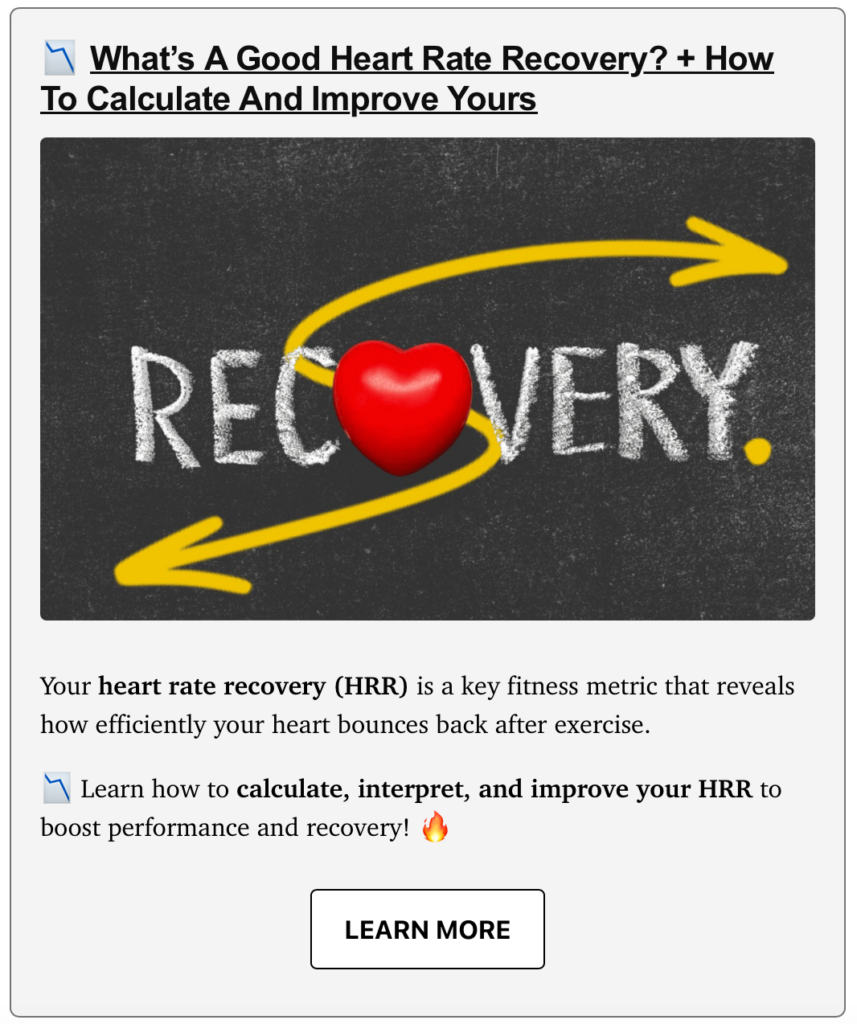
And then there’s this example (from the same Marathon Handbook newsletter)
I’m not going to go deep into this one, but will say that this is where discernment is highly advised. Again, there’s some good and helpful information in the post, like defining what heart rate recovery is, but don’t take the numbers (like your max heart rate and resting heart rate based on age range) to heart. Pun intended. You and your heart rate are unique to you. If you really want to know and get accurate measurements, contact an exercise science lab or speak to a cardiologist who studies and specializes in athletes.
Now I’m not meaning to slam on Marathon Handbook. I’ve exchanged friendly emails with its founder, Thomas. Amby Burfoot is their Editor at Large. Katelyn, Michael, and Alex do a really great video podcast. Alex, their contributing editor debuted in the half marathon back in October with a 65:58. There’s a ton of credibility.
The tl;dr as the kids say is: keep it simple. Don’t overcomplicate running. Don’t believe everything you read, see, or hear, and definitely when it comes to “influencers.” Don’t compare yourself to others. Unless, of course, you’re racing against certain others and your goal is to beat them. Even then, if you don’t get the expected result, don’t sweat it. Learn from it and have fun with it. That’s what this whole life and running thing is all about.
Running is simple. Don’t overcomplicate it. And that goes for your running apparel. If you’re starting out, use what you have and wait to see and figure out what you need. Don’t rely on what reviews, websites, ads, and “influencers” tell you that you need.
I started running on July 11, 2013. I didn’t have “running gear.” When I decided to walk to the Gorzycki Middle School track and run one mile (that was my foray into running), I was wearing
A cotton t-shirt
A pair of “athletic shorts” that I think I’d gotten as a Christmas or birthday present from my parents, and were probably just some random inexpensive pair of polyester shorts that my mom found at Sam’s Club
Whatever socks I had in my sock and underwear drawer. Probably cheap, standard-issue cotton socks from Walmart
A pair of Nike Lunarfly shoes that were given to me by my neighbor, Sandy, who is the mom of famed running back Ricky Williams. I was wearing Ricky Williams’s shoes!
I knew absolutely nothing about running apparel. I did absolutely fine on my first 1-mile run (other that nearly dying from the actual running part because I was an unhealthy, overweight, and sedentary human).
The white and yellow/green shoes in the front row were my Nike Lunarfly’s that I’d inherited from Ricky Williams and were my very first pair of running shoes. I don’t even know if they were designed to be running shoes.
A week later, when I’d decided that I was to commit to running, I treated myself by going out to buy myself some running clothes. I had no idea what to buy or where to buy it. So, naturally, I went to Target and picked out a couple “athletic” polyester t-shirts and pairs of shorts. If I had to guess, I’d say that a shirt and a pair of shorts were $10-$15 each.
SHORTS
After some weeks or months, I decided to upgrade my running apparel and went to Academy Sports and Outdoors and bought myself some house brand (BCG) running shorts. I still buy and run in those same $20 shorts today. I’ve run ultramarathons, traversed the Grand Canyon, run the Boston Marathon four times now, and probably a dozen other marathons, and ten of thousands of miles in $20 BCG shorts from Academy. And they’ve done just fine. I have a friend who swears by the $80 shorts he gets from Patagonia. I don’t get it.
SHIRTS
Over the last 11 years I’ve amassed athletic/technical shirts from races. I wear my old race shirts for 99% of the miles that I run. I mean, you have to pay for a race registration, but I always like to think of the race shirt as “free.” In the warmer months I’ll often run shirtless.
Wear whatever is comfortable and works for you. If style and outfit coordination is important to you, then by all means, buy what makes you look and feel good. After a run at effort you’re going to be a sweaty, hot mess, so does it really matter?
SPORTS BRA
For women, I would recommend researching and investing in good sports bras. I wouldn’t recommend trying to save a buck here. I know this because I live in a house full of women, and I work with and coach a lot of women, and I’ve heard feedback on sports bras. Get fitted. Try on as many bras as it takes until you find what works for you. And don’t just settle. Take the time and find and invest in the sports bra that works for you. Just like running shoes, it has to feel like it was made just for you. Just like feet, no two busts are the same.
SHOES
This is probably the most-asked question. Which shoes should you buy to run in? The answer: whatever works for you. Like bras above, they have to feel comfortably and serve you. DO NOT RELY ON MARKETING TO TELL YOU WHAT RUNNING SHOES TO BUY AND WEAR. In that same vein, don’t rely on what your friend tells you. Don’t rely on what the guy at the run club tells you. Don’t rely on what social media tells you. Don’t rely on what you see the elites wearing. Don’t rely on the cute/fancy/flashy shoes that you see at a race. Go get fitted for running shoes at a run specialty retailer, a podiatrist, a sports doctor (who has experience with runners/walkers/hikers). Don’t just buy a pair of running shoes on Amazon or some running warehouse online discounter site unseen. And don’t be cheap about it. Running shoes is where you should invest the most. You’re obviously using your feet when you run, and there’s a lot of pounding and employing of sensitive and fragile foot bones, muscles, tendons, and ligaments. You need to protect, support, and strengthen those those musculoskeletal assets if you want to stay a happy and healthy runner.
There are all kinds of brands and models of running shoes. Take your time and try on shoes. If you can’t figure it out in one sitting, that’s fine. Take your time. I can’t emphasize that enough. You don’t want to settle here. You might luck out early and find the pair(s) that feel like they were custom made for you. It could take hours and weeks. Invest the time (and money) in good running shoes that fit and serve you. And, again, make sure to get fitted. you might have a high arch or wide ball of your foot or a narrow foot or plantar fasciitis or weak ankles or any kind(s) of uniqueness to both or either of your feet. Take the time, work with a professional, and find the shoe that fits and serves you.
SOCKS
I invest in socks too. I think it’s absolutely crazy that I own socks that cost me $30 for a pair, but I have noticed a difference. And, like shoes, it’s a personal preference. My feet get sensitive after a while of running, so, over time, I learned that having a good pair of socks helps while I’m running, and in my recovery after a hard bout or a really long training run or a race. I like socks that have extra padding built into the bottoms for extra cushioning. You might have feet that are tough as nails and can get away with a 10-pack of athletic socks online or from the big box or club store.
SIMPLE SUMMARY
The long & short of it is: keep it simple. You don’t need spend a lot of money or keep up with the Joneses in running (or in life), especially when it comes to your running outerwear. Invest in the important things that support health and function (specifically shoes, and bras for the women). Expensive Patagonia shorts and lululemon tops aren’t going to make you train better or get to the finish line faster.
I’m having a HeartSaver CT scan on Friday morning to check for heart disease, specifically for calcium deposits in my heart’s arteries. Sparing the details of a 2014 study where the conclusion was: “long-term male marathon runners may have paradoxically increased coronary artery plaque volume.”
That means if I have significant calcium build-up in my heart’s arteries, I could drop dead at any moment from doing the thing that I love to do. Live by the sword, die by the sword, I guess.
My dad died way too young from heart disease. I want to hang on for as long as I can. And I haven’t run my best marathon yet.
Thanks be to Mario Fraioli and Brendan Leonard for inspiring me to take a step in checking up on my heart health and hopefully I can keep this engine humming for some years to come.
I have an interest in the science of sport and physiology. But I’m no scientist of physiologist. I get the basic concepts. One of which is heat training. I’ve read a bit about heat training but I’ve experienced it a hell of a lot more than I’ve studied it.
And I have a lot of personal experience with the effect of heat training. I enjoy running, so I run year-round. And that includes the blazing hot and long summers in Central Texas. And when race seasons comes around in the fall and winter, it becomes easier to run fast. My basic, non-scientific explanation to myself and athletes that I work with is that the body isn’t have to work as hard to keep the core body temperature regulated, so that “extra” blood volume can be used to fuel the running muscles.
Reading this recent article on Jacob Sommer Simonsen destroying the Danish marathon record was kind of a “duh” moment for me. I have to remember that many parts of the world don’t have our Texas oppressive heat. Full disclosure: I didn’t read that linked article in its entirety (yet). But I get the gist. Is the same gist as my basic, non-scientific explanation in the paragraph above. You train in the heat and you can get faster and/or more efficient.
I did get to the part in the article where hemoglobin is discussed. I knew hemoglobin was part of our blood, but I didn’t recall what we actually needed it for. I’m sure I did at one point (like in 8th grade science). Hemoglobin is a protein in red blood cells that carry oxygen from the lungs to our muscles and organs. Hemoglobin density is increased by consuming foods high iron. Foods like red meat, spinach, and beans are high in iron.
A state-of-the-art and stunningly-designed running facility with accommodations such as an 8-lane outdoor track, training facility, weight rooms, showers, Buc-ee’s-like bathrooms, locker rooms, meeting and conference rooms, studio, lounge, coffee and juice bars, a bar bar, and the best barbecue in Central Texas, tucked in a beautifully-landscaped plot of land in the hill country. Phase II would introduce an indoor track and kolaches.
Our Danish, Kenyan, Norwegian, and everyone from around the globe would be crawling over each other to come and experience, train, and stay here.